Book Appointment Now

8 Best Fish Finder Kayaks for 2026: Smarter Small Boat Fishing
ByBEGUM
Fishing from a kayak rewards portable electronics that fit a cramped cockpit without hiding useful information. A fixed fish finder can add accurate depth and structure readings, while a handheld unit or underwater camera offers flexibility for changing water, weather, and launch points. I focus on sonar range, display readability, transducer placement, power needs, and realistic fit for Hobie, FeelFree, and other fishing kayaks.
Helix 5 CHIRP DI GPS G3 combines a compact 5-inch color screen with two CHIRP sonar modes. Dual Spectrum CHIRP scans either broad coverage or a narrower target view, while Down Imaging reduces visual clutter around fish and submerged structure. That balance makes it practical for anglers moving between shallows, channels, and lakes.
Balanced sonar control for small cockpits
Everyday fishing with CHIRP detail
The Main Contenders
PickWhy I Picked ItBest ForAction

Balanced Choice
Humminbird 411670-1 Helix 5 CHIRP DI GPS G3 Fish Finder
Balanced sonar for small cockpits
Everyday kayak anglers

Premium Pick
Humminbird XPLORE Series GPS Fish Finder
Large display with MEGA imaging
Premium fishing setups

Comfort Choice
BerleyPro Raised Kayak Handle for Hobie Outback and Compass
Secure grip during active fishing
Hobie fishing kayaks

Feature Rich
FishPRO 2026 HD 1080P Underwater Fishing Camera
Large underwater viewing screen
Ice and shallow-water fishing

Professional Pick
Lowrance Elite FS Fishfinder and Chartplotter
Integrated sonar and navigation tools
Chartplotter-focused anglers

Budget Friendly
LUCKY Kayak Portable Fish Depth Finder FFC1108
Portable depth tracking with wide range
New kayak anglers

Heavy Duty Pick
BerleyPro Bumper Bro Kayak Keel Guard
Hull protection on rough landings
Fishing from rocky shorelines
Beginner Friendly
LUCKY Portable Wired Kayak Fish Finder
Simple wired depth readings
First-time sonar anglers
The Details Behind The Selections
The 5-inch color display gives a kayak cockpit useful information without taking on the visual footprint of a 10- or 12-inch unit. It suits anglers moving through varying depth, and the compact screen may be easier to scan than a larger model while the boat is rocking.
Compared with the LUCKY portable options later in this roundup, the Helix 5 provides a more structured fixed-mount approach. GPS and mapping support make it the sensible fit for anglers returning to marked fishing areas rather than only checking immediate depth.
The Upside
- Dual Spectrum CHIRP supports broad coverage and detailed scanning modes.
- CHIRP Down Imaging helps separate fish and structure from visual clutter.
- The 5-inch color display balances detail with cockpit space.
- Internal GPS supports navigation to recurring fishing spots.
Small Caveats
- Fixed installation requires planning around the kayak’s power and mounting positions.
- The display is smaller than the Humminbird XPLORE options for detailed chart work.
At A Glance
Built With In Mind
This model benefits recreational and intermediate anglers who want detailed sonar without a full-size electronics console.
A Better Fit Elsewhere
The Humminbird XPLORE Series GPS Fish Finder suits anglers who prioritize a much larger display and broad side-imaging coverage.
The XPLORE Series centers on a large HD touchscreen in 10- or 12-inch formats, with side imaging and compatibility for forward-facing sonar. For a spacious fishing kayak or small pontoon-style setup, that screen can make structure, routes, and saved locations easier to interpret during active fishing.
This is a step beyond the Helix 5 in screen area and navigation scope, although cockpit dimensions become decisive. The control-head-only configuration also means the transducer, mounting hardware, and compatible setup must be considered separately.
Reasons It Performs
- Large display options support detailed sonar and chart interpretation.
- MEGA Side Imaging surveys a broad area beside the kayak.
- Compatibility with forward-facing sonar broadens installation choices.
- Waypoint syncing can organize a large personal fishing database.
Trade Offs
- A large touchscreen needs a stable, unobstructed mounting location.
- Control-head-only availability may leave transducer compatibility unresolved.
- Owners must manage more settings and navigation data than a handheld unit presents.
Feature Snapshot
Who It Suits Best
This series fits anglers with a roomy kayak console who value large-screen sonar, charting, and networked controls.
Look Elsewhere When
The Humminbird 411670-1 Helix 5 CHIRP DI GPS G3 fits anglers with limited mounting space and a preference for a smaller display.
This is not an electronic fish finder, but it directly supports kayak anglers who stand, brace, and move around while handling a rod or checking electronics. The raised position provides a handhold away from lower frame areas, which may feel more secure during launches, wind, and active fishing.
The CNC-machined aluminum body and stainless steel fasteners suit a durable boating environment, but model compatibility is the deciding factor. It is intended for Hobie Outback and Compass kayaks rather than a universal fit.
What Helps Most
- Raised placement offers a reachable grip during entry and exits.
- Aluminum construction suits frequent outdoor exposure.
- Stainless steel fasteners resist corrosion-prone marine use.
- The handle adds leverage when standing or stabilizing the kayak.
Details To Watch
- Compatibility is limited to specified Hobie models.
- Mounting hardware must be checked against the existing hull and hardware before installation.
Made For
Hobie Outback and Compass owners who fish upright and need a more secure handling point are the primary fit.
Another Choice May Suit
The BerleyPro Bumper Bro Kayak Keel Guard suits FeelFree owners who need hull protection rather than an additional grip point.
The FishPRO camera offers a direct visual view rather than a sonar trace, making it useful around ice holes, shallow lakes, and submerged cover. Its 7-inch IPS display provides a larger viewing area than a handheld depth unit, while the 10,000mAh battery is designed for extended outings away from a charging point.
Compared with the LUCKY FFC1108, the FishPRO trades numeric depth and sonar separation for a camera image. For kayak fishing in clear water, that difference may matter more, particularly near vegetation or structure.
Good Reasons To Consider
- The 7-inch IPS panel makes close visual inspection more comfortable.
- 1080P video provides an alternative to traditional sonar graphics.
- LED and infrared illumination supports varying underwater visibility conditions.
- The stated 82-foot cable reaches beyond a typical kayak hull depth.
- USB-C charging simplifies routine power management.
Practical Considerations
- Video clarity can decline in murky, tannic, or aerated water.
- The camera requires careful cable routing to avoid snagging around the kayak.
- Lens cleaning and drying are necessary between repeated deployments.
Quick Facts
Right Fit For
Ice anglers and clear-water kayak anglers benefit most from this direct visual approach.
Consider Something Else When
The LUCKY Kayak Portable Fish Depth Finder FFC1108 suits anglers who prefer portable depth readings over camera placement and cable management.
The Elite FS combines fish-finding and chartplotter functions in a single Lowrance setup, with configurations available with or without a transducer. That choice matters because an existing compatible HDI transducer can avoid a full replacement while still supporting the combined sonar package.
Active Imaging 3-in-1 combines CHIRP, SideScan, and DownScan, while FishReveal helps separate targets from the surrounding return. Compared with the Helix 5, the Lowrance option fits anglers who want sonar and chart navigation managed through the same ecosystem.
The Value In It
- CHIRP supplies detailed target information across supported modes.
- SideScan surveys structure beside the kayak.
- DownScan looks beneath the boat for fish and cover.
- FishReveal processing makes target returns easier to interpret.
- With-transducer and no-transducer options support different existing setups.
Some Limits To Know
- Configuration must be checked carefully to receive the required transducer and cable.
- Three sonar views increase the setup involved compared with a single handheld unit.
Core Details
Who Should Grab It
Lowrance anglers who already use its navigation tools benefit most from the integrated sonar and chartplotter approach.
Where A Sibling Pick Shines
The Humminbird 411670-1 Helix 5 CHIRP DI GPS G3 suits people seeking a smaller fixed display with focused sonar modes.
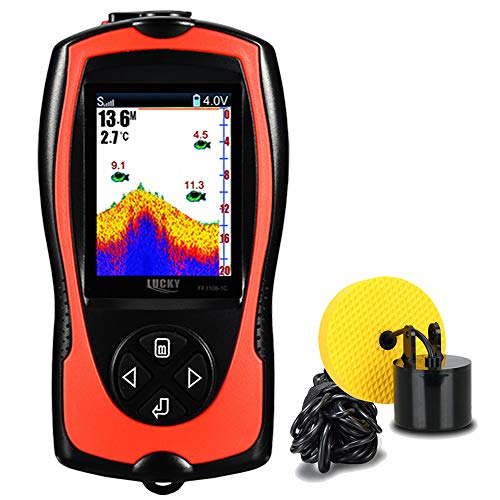
The LUCKY FFC1108 keeps things approachable for a first kayak electronics setup. Its handheld display gives approximate depth and fish-location information, while a detachable sonar sensor can attach to a kayak or boat hull to track changing depth from a moving craft.
Its 3-to-328-foot detection range covers shallow paddling and substantially deeper water. That range is useful, though the portable format cannot match the side imaging, charting, and larger displays found in the Humminbird and Lowrance systems.
The Good Stuff
- Portable format fits neatly into a limited kayak storage area.
- Hull attachment supports depth changes while paddling.
- A 3-foot minimum reading suits very shallow water.
- The 328-foot range extends well beyond typical kayak draft.
Where It May Fall Short
- The LCD provides less visual detail than color sonar displays.
- Approximate readings cannot replace the target separation of CHIRP systems.
- The sensor lead and attachment require attention to prevent hull damage or snagging.
Best Suited To
New kayak anglers benefit most from its simple display, broad depth range, and minimal control layout.
A Better Fit Elsewhere
The Lowrance Elite FS Fishfinder and Chartplotter suits intermediate anglers who need side scanning, down imaging, and integrated navigation.
The Bumper Bro does not locate fish, but it helps protect the hull of a FeelFree kayak during launches, portages, and contact with hard surfaces. Fishing electronics add weight, cables, and mounting hardware, making hull protection a sensible supporting part of the same setup.
Thermoformed ABS polymer is denser and tougher than the kayak hull while retaining enough flexibility for changing contact forces. The trade-off is model-specific fit, so the kayak hull needs to be compared with the guard’s intended mounting area before installation.
What It Does Well
- Protects the keel, bow, and hull from abrasion on rough surfaces.
- Flexible ABS construction absorbs contact better than rigid plastic.
- Supports repeated launches from gravel, concrete, and rocky banks.
Points To Note
- The guard is intended for FeelFree kayaks and requires model-compatible positioning.
- Incorrect placement may leave hull sections exposed or interfere with handling.
Technical Sheet
Who Will Love This
Fishing kayak owners who routinely launch from rough shorelines value the added buffer between the hull and hard ground.
Skip It When
The BerleyPro Raised Kayak Handle for Hobie Outback and Compass suits Hobie owners who need hand control rather than FeelFree hull protection.
The wired LUCKY unit provides a straightforward way to add depth, temperature, contour, and broad fish-size information to a kayak. Its 2.4-inch color TFT display is small enough for a compact cockpit, although it offers less room for menus and sonar graphics than a fixed chartplotter.
Simulation mode lets a new user learn the display before connecting the transducer on the water. Compared with the LUCKY FFC1108, this model presents more environmental information, though the permanent cable connection adds another cable to secure around the kayak.
The Case For It
- Depth, temperature, contours, and fish-size data share one display.
- Simulation mode reduces the learning curve before deployment.
- The compact screen fits storage in a smaller fishing kayak.
- Fish-size categories provide a simple alternative to advanced target interpretation.
Room For Improvement
- The wired sensor cable needs careful routing around the hull and paddle.
- The 2.4-inch display limits detailed chart and sonar interpretation.
- Fish-size categories are less precise than a multi-mode CHIRP system.
The Right Fit
This model suits first-time anglers who want several basic readings in a compact, wired kayak setup.
Reach For A Different Pick When
The LUCKY Kayak Portable Fish Depth Finder FFC1108 suits anglers who prefer a detachable hull sensor and fewer displayed variables.
What Matters Before Choosing Kayak Electronics
Display size and cockpit room
A larger screen can show more structure and navigation detail, but it also needs a stable mounting position. Small cockpits often favor the 5-inch Humminbird Helix 5 or a handheld unit, while a 10- or 12-inch display makes more sense in a roomy console setup.
Sonar modes and actual use
CHIRP provides frequency sweeps that can improve target separation and reduce noise. Down Imaging emphasizes structure below the kayak, while SideScan covers the water to either side. An angler fishing deep structure may need side coverage, whereas a depth-focused beginner may get more use from a simpler sonar display.
Transducer and power compatibility
A transducer sends and receives sonar signals, so its compatibility determines which displays can be used. Confirm the included or excluded transducer, cable length, power source, mounting location, and fuse requirements before installation. This check matters most with control-head-only systems such as the Humminbird XPLORE Series.
Portability and cable control
Portable units are easier to store and move between kayaks, while wired sensors provide steadier connections. Route every cable away from paddles, line, drains, and hull edges, and add a strain relief at the sensor connection. Protection hardware such as the BerleyPro Bumper Bro also matters on rough launch surfaces.
Practical Choices Before Installation
Hidden Buying Traps
Display size often receives more attention than transducer compatibility, yet the transducer controls the actual sonar link. Confirm whether the kit includes one, which models accept it, and how the cable reaches the kayak. Also account for battery capacity and protected power connections before choosing a permanently mounted display.
The Upgrade Payoff
Higher-end displays add screen area, mapping, networking, and multiple sonar perspectives, but those benefits matter only on a kayak with sufficient mounting room. Larger models suit anglers studying structure across a wide area, while compact or handheld systems remain more practical for limited storage and frequent equipment changes.
