Book Appointment Now

7 Best Kayak Measuring Board Options for 2026
ByIMRAN
As anglers prepare for the 2026 season, a concise review of the top kayak measuring boards highlights accuracy, durability, and portability. Choices range from rigid, tournament‑ready aluminum rulers to buoyant EVA foam tapes and compact roll‑ups, each with tradeoffs for mounting, true‑zero fences, and photo verification. The following selections clarify which features matter most and why one could suit a specific kayak setup better than another.
40″ EVA Foam Boat Fish Measuring Ruler

Should you fish from a kayak or small boat and need quick, reliable measurements, the 40″ EVA foam boat fish measuring ruler is a smart choice-its peel-and-stick EVA foam stays put on curved decks, the non‑skid brushed surface keeps slippery catches steady, and CNC‑carved marks with extra‑large numbers let you read and photograph lengths up to 40″ instantly. You’ll get a durable, accurate standard scale in a 41.9 x 4.5 in package; make certain your craft has room. Install on smooth surfaces with the strong adhesive, or sand and add glue for uneven decks. It’s ideal for boats, docks, kayaks, and other quick measurements.
Best For: anglers using kayaks, small boats, or docks who need a quick, durable, and easy-to-read measuring solution for catches up to 40″.
Pros:
- EVA foam with brushed non‑skid surface and CNC‑carved marks provides durable, slip‑resistant, and accurate measurements that photograph well.
- Peel‑and‑stick strong adhesive backing fits curved decks and installs quickly on smooth surfaces.
- Extra‑large numbers and up to 40″ measurable length make rapid measurement simple for most recreational fishing needs.
Cons:
- Overall size (41.9 x 4.5 in) requires sufficient deck space and may not fit very small kayaks or cramped cockpit areas.
- Adhesive may not bond well to dirty or uneven surfaces without sanding or additional glue.
- Limited to 40″ measurement-too short for very large fish or specialized tournament requirements.
YakAttack LeaderBoard 28″ Kayak Fish Measuring Board

In case you’re competing in catch-photo-release tournaments or just demand precise, repeatable measurements, the YakAttack LeaderBoard 28″ is built for you - its 28″ surface with 1/4″ increments, mirrored nose fence, and angled cradle deliver glare-free, accurate photos that meet KBF and other official standards. You’ll appreciate the wider profile and DoubleTake visual indicator that guarantees proper nose placement. Tournament-ready features include dual flip-out ID holders for standard cards, built-in sliding cull tabs, and clear, easy-to-read measurements. EVA foam underside adds buoyancy and a tether point secures the board. Made in the USA and available in multiple colors.
Best For: anglers who compete in catch-photo-release tournaments or anyone needing a durable, tournament-compliant measuring board for repeatable, glare-free fish measurements.
Pros:
- 28″ surface with 1/4″ increments, mirrored nose fence, and DoubleTake indicator for highly accurate, repeatable measurements that meet KBF standards.
- Tournament-ready features including dual flip-out ID holders for standard cards and built-in sliding cull tabs for quick tracking.
- EVA foam underside for buoyancy and a tether point for secure attachment; made in the USA with multiple color options.
Cons:
- Tether not included, so buyers must purchase a leash separately for secure attachment.
- 28″ length may be insufficient for very large fish or anglers who need a longer measuring surface.
- Plastic construction and built-in features may add bulk for paddlers seeking an ultra-minimalist setup.
KETCH X Fish Measuring Board/Ruler
May 9, 2026 7:56 pm

Provided you need a tournament-ready, durable measuring board, the KETCH X Fish Measuring Board/Ruler is built for competitive kayak anglers who demand accuracy and ruggedness. You get an extruded aluminum board with engraved, high-contrast markings that stay readable in bright sun or low light. It’s contoured to cradle large fish and includes tether holes at the far end for secure attachment. Dimensions are 27 1/8″ x 4-5/8″ x 1-1/4″. Made 100% in the USA, it’s approved through KBF, Hobie B.O.S., and B.A.S.S Kayak Series, and is the industry standard for catch-photo-release events. It does not float.
Best For: Competitive kayak anglers and tournament participants who need a durable, tournament-legal measuring board for accurate catch-photo-release measurements.
Pros:
- Extruded aluminum construction with engraved, high-contrast markings for long-lasting visibility and accuracy.
- Contoured sides and tether holes help cradle fish securely and allow for easy attachment during tournaments.
- Made 100% in the USA and approved by KBF, Hobie B.O.S., and B.A.S.S Kayak Series.
Cons:
- Does not float, so it can be lost if dropped overboard.
- Relatively short length (27 1/8″) may be limiting for measuring very large fish.
- Rigid metal construction may be less comfortable to handle than softer, padded alternatives.
Tada 48in Roll-Up Folding Fish Measuring Tape
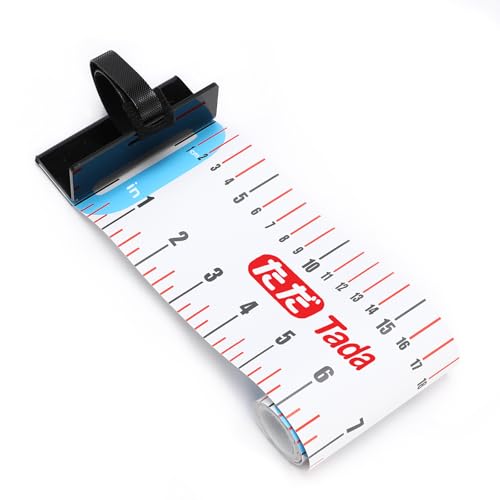
Should you need a compact, waterproof measuring solution for both saltwater and freshwater outings, the Tada 48in Roll-Up Folding Fish Measuring Tape is built for you: its high-quality PVC construction floats should it be dropped and rolls up with a hook-and-loop strap so it fits neatly in a tackle box or pocket while a precise bump board and bold dual scales give fast, accurate length readings. You’ll get 48 inches (122 cm) of measurement with inches to 1/2″ and centimeters to 1 cm, clear low-light markings, and a tangle-free roll-up design. Use it for catches, gear, ice holes, or general measuring.
Best For: Anglers and outdoor enthusiasts who need a compact, waterproof, and durable measuring tape for accurately measuring fish and gear in both saltwater and freshwater environments.
Pros:
- Floats and is waterproof PVC, so it survives drops and wet conditions.
- Precise bump board plus bold dual scales (inches to 1/2″ and cm to 1 cm) for fast, accurate readings even in low light.
- Roll-up, tangle-free design with hook-and-loop strap fits easily in a tackle box, bag, or pocket.
Cons:
- Maximum length of 48 inches (122 cm) may be too short for very large fish.
- PVC material may eventually wear or crease with heavy, prolonged use.
- Lacks a rigid, built-in straight edge for measurements of very large or uneven catches.
Fishing Online Hawg Trough Fish Measuring Board
May 9, 2026 7:56 pm

Should you want a bright, easy-to-read board for quick catch-photo-release measurements, the Fishing Online Hawg Trough is a top choice-kayak bass anglers and tournament participants will appreciate its fluorescent yellow plastic, raised quarter-inch measuring lines, and bold black numbers (though some versions could lack blackening). You’ll find a 30-inch length that fits most kayak decks and handles typical bass sizes. The Fishing Online logo marks authenticity, and the raised increments help steady fish for photos. Before using it in a tournament, check approval with the director. It’s simple, durable, and focused on fast, accurate catch-photograph-release measuring.
Best For: anglers-particularly kayak bass fishermen and catch-photo-release tournament participants-who want a bright, durable, easy-to-read measuring board for quick fish photos.
Pros:
- Fluorescent yellow plastic and bold raised quarter-inch increments make measurements quick and highly visible in photos.
- 30-inch length fits most kayak decks and accommodates typical bass sizes.
- Simple, durable design with Fishing Online branding for authenticity.
Cons:
- Some versions may lack blackened lines, reducing contrast and visibility.
- Not automatically tournament-legal-must be verified with the tournament director before use.
- Plastic board may flex or scratch over time, potentially affecting long-term accuracy.
YakAttack LeaderBoard 28″ Kayak Fish Measuring Board

Should you need a tournament-ready measuring board that’s built for accuracy and durability, the YakAttack LeaderBoard 28″ is a top pick. You’ll get a 28″ surface marked in 1/4″ increments and a DoubleTake Visual Indicator-mirrored surface and doubled gap-to eliminate ambiguity. It meets tournament specs and uses marine-grade UV-stabilized polymers for long-term accuracy. Dual flip-out ID holders and two resealable sleeves make verification simple. Three black culling tabs help quick comparisons and track personal bests. EVA foam adds flotation and a tether point prevents loss. The board’s clear markings and sturdy build stand up to repeated field use.
Best For: tournament anglers and kayak fishermen who need a durable, highly accurate, and tournament-ready measuring board for reliable catch verification.
Pros:
- Precise 28″ measuring surface in 1/4″ increments with DoubleTake Visual Indicator to eliminate measurement ambiguity.
- Tournament-focused features (dual flip-out ID holders and resealable sleeves) simplify verification and photo documentation.
- Buoyant EVA foam inlay and built-in tether point prevent loss and ensure usability on water.
Cons:
- 28″ length may be limiting for anglers who catch fish longer than the board’s capacity.
- Made of rigid polymer-may be bulkier than foldable or soft measuring solutions for storage.
- Tournament-focused design could include features unnecessary for casual anglers, adding cost/complexity.
KETCH Keeper – Fish Measuring Board/Ruler Holder
--
In case you want a secure, low-profile way to mount a measuring board on your kayak, the KETCH Keeper is built to fit Ketch X, Ketch Karbonate, and Original Ketch boards and keeps a ruler ready wherever you paddle. You can mount the Keeper almost anywhere and choose between the Standard Kit for t-track installation or the Krate Kit for direct fastening. Standard includes two 10-32 x 3/8″ bolts and t-nuts; Krate supplies four 10-32 x 1″ bolts, nylon lock nuts, and washers. All hardware is stainless steel. Reminder: it won’t fit Ketch 64″ Big Game boards.
Best For: anglers who want a low-profile, secure way to keep a measuring board or ruler mounted on Ketch X, Ketch Karbonate, or Original Ketch kayaks (not compatible with Ketch 64″ Big Game boards).
Pros:
- Compatible with multiple Ketch board models and mounts almost anywhere on the kayak.
- Comes with two hardware kit options (t-track Standard Kit or direct-fastening Krate Kit) to suit different setups.
- All hardware is stainless steel for corrosion resistance.
Cons:
- Not compatible with Ketch 64″ Big Game boards.
- Standard Kit includes only two bolts/t-nuts, which may limit mounting options compared with the Krate Kit.
- Requires appropriate t-track or drilling for installation depending on chosen kit.
Factors to Consider When Choosing a Kayak Measuring Board
Upon selecting a kayak measuring board, anglers should weigh measurement accuracy and clear scale markings against material durability and resistance to UV and saltwater. Portability and storage footprint matter for small cockpits, while tournament compliance features and secure mounting options determine at what point a board is competition-ready. Consideration of installation method and aggregate build quality helps balance practicality with rule adherence.
Measurement Accuracy & Scale
Select a measuring board that prioritizes precise, repeatable readings via matching its length to legal and tournament limits, featuring high-contrast, fine-increment graduations (quarter-inch or 1 cm), durable recessed or engraved markings, a true zero or secure bump stop for consistent snout placement, and a rigid, UV- and thermally-stable material to prevent warping that would compromise scale accuracy. The board should exceed the largest expected legal minimum prior to 2–4 inches to accommodate big specimens. Recessed or embossed scales resist wear and remain readable whenever wet or abrasive. Fine graduations reduce uncertainty on borderline fish, and a reliable head fence eliminates placement variability. Inspect indexing for clarity at typical eye distance and confirm the zero point aligns precisely with the measurement plane for repeatable, defensible results.
Material Durability
Durability governs a measuring board’s long-term accuracy and usability on saltwater and sun-exposed outings: choose marine-grade polymers, anodized or extruded aluminum, or closed-cell EVA foam that resist UV degradation, corrosion, and warping. Materials should feature engraved or CNC-carved markings rather than printed scales so measurements remain legible after abrasion, cleaning, and salt exposure. Closed-cell foam or intentionally floatable constructions prevent waterlogging and dimensional change; non-floating metals demand secure tethering and corrosion management. Edge and surface treatments such as anodizing, powder coating, or sealed PVC reduce chipping, flaking, and thermal/humidity-induced instability. Finally, evaluate hardware and attachment points for stainless or marine-grade fasteners and reinforced mounting areas to avoid stress fractures, loosening, and failure from repeated impacts and heavy use.
Portability & Storage
For paddlers who must balance limited hatch space and easy access, portability and storage determine whether a measuring board is practical on frequent kayak outings. Compact options like roll-up or folding measuring tapes suit tackle boxes, backpacks, and small hatches, while rigid boards demand more planning. Assess overall dimensions and whether a board stows flat or requires deck space; longer rigid models might need deck mounts or external straps. Lightweight materials and buoyant foam undersides reduce bulk, ease carry, and aid retrieval in case dropped. Check packed thickness and weight-thin PVC or foam typically occupy less space and weigh less than aluminum or hard plastics. Seek boards with straps, sleeves, or mounting hardware to secure them during transport and prevent rattling or accidental unrolling.
Tournament Compliance Features
Make sure any measuring board under consideration strictly conforms to the tournament’s stated requirements for dimensions, scale increments, and orientation, since noncompliant boards can lead to disqualification or rejected measurements. The ideal board specifies required measuring surface length and allowable increment spacing (for example 1/4″ or 1/2″) and presents graduations in the mandated orientation. It provides a secure, visible method for competitor ID display-clear sleeves or dedicated slots-when events require ID in catch-photo-release submissions. Tournament-approved features include a definitive nose fence or head-stop to eliminate placement ambiguity. Marking contrast, numeral size, and graduation clarity must satisfy photo-readability standards. Anti-tamper and calibration assurances-engraved, permanent markings and warp-resistant materials-preserve measurement integrity throughout competition.
Mounting And Installation
During selecting a mounting and installation approach, anglers should initially verify that the kayak or boat has a flat, appropriately oriented surface long enough to accommodate the board’s full measurable length and allow unobstructed access to graduations; they must then choose a compatible attachment method (peel-and-stick, t-track, or through-bolting) that suits hull material and surface condition, confirm hardware type and length to avoid interference with internal compartments, plan for a tether or retention option to prevent loss, and favor mounting locations and methods that permit quick removal or compact storage to prevent obstruction during paddling. Installers should sand textured areas or add adhesive backing for better bonding, select bolt lengths and washers to clear hull structures, fit a tether point, and prioritize positions enabling rapid detachment for transport.
Buoyancy And Security
Once mounted or tethered, attention shifts to buoyancy and security to guarantee the board remains with the kayak should it go overboard. The ideal measuring board features flotation or an EVA foam underside to keep it afloat in case it’s dropped, minimizing permanent loss. A built-in tether point or attachment hole allows a leash to prevent drifting in currents or wind. Weight and profile matter: lighter, low-profile boards resist shifting and wind, whereas bulky designs can snag or blow off the deck. Mounting and tether hardware should be corrosion-resistant-stainless or marine-grade-for longevity in salt and fresh water. Any buoyant inserts must be securely bonded to withstand repeated wet/dry cycles and preserve consistent flotation over time.
Readability In Photos
Readability in photos is a critical selection criterion for a kayak measuring board because clear, accurate images are often the final record of a catch. Large, high-contrast numbers and markings guarantee legibility in low light or glare. A non-reflective, matte surface and an angled cradle reduce glare and shadows, keeping the fish and scale distinct. Fine measurement increments (quarter-inch or centimeter resolution) allow photographed readouts to convey precise length. Proper placement-nose tight against the fence and the camera perpendicular to the measuring plane-minimizes parallax and preserves accuracy in images. A dedicated ID card pocket or designated area near the scale permits tournament cards or identifiers to appear clearly in the same frame as the measurement.
Multi-Purpose Functionality
While primarily designed to record fish length, a versatile kayak measuring board also functions as a compact utility tool for anglers who need to multitask on the water. Boards with dual-scale markings (inches and centimeters) accommodate varying regulations and user preference. Built-in cull tabs, ID/card holders, and tether points enable tournament ID display, catch tracking, and secure attachment to the kayak. Flotation or buoyant undersides plus non-slip surfaces allow the board to act as a floating cradle and produce stable, glare-free CPR photos. Portability features-folding, roll-up designs, or lightweight construction-facilitate storage in tight compartments and use for other gear measurements. Durable, waterproof materials with engraved or raised markings guarantee long-term reliability in harsh marine conditions.
Frequently Asked Questions
Can Measuring Boards Handle Saltwater Corrosion Long-Term?
Yes. He observes that many measuring boards can resist saltwater corrosion provided constructed from marine-grade materials (anodized aluminum, stainless steel, high-density plastics) and maintained with regular rinsing, drying, and periodic protective coatings to guarantee long-term durability.
Are Measuring Boards Legal for Tournament Use Without Certification?
A sharp ruler slices uncertainty: no-most tournaments require certified measuring boards or approved methods. Organizers set rules; using uncertified boards risks disqualification. Competitors consult event regulations and seek certification or official approval beforehand.
How Do I Transport a Rigid Board on Small Kayaks Safely?
They secure the rigid board parallel to the hull using deck bungees or cam straps, pad contact points with foam, avoid overhanging weight, lock with quick-release clips, and stow leashes or spare gear to prevent shifting or snagging.
Can I Mount a Measuring Board on an Inflatable Kayak?
Yes; one can mount a measuring board on an inflatable kayak, though it requires reinforced attachment points and low-profile hardware. Like a careful whisper, proper seam-friendly straps and adhesive patches protect the hull while securing measurements reliably.
Do Measuring Boards Affect Kayak Stability While Paddling?
They generally have minimal effect; a lightweight, low-profile measuring board mounted near the stern or centerline causes negligible stability change, while oversized or high-mounted boards can slightly alter balance and tracking, especially in narrow or light kayaks.