Book Appointment Now

Best Fishing Pedal Kayak for 2026: Glide, Cast, Repeat
ByIMRAN
The 2026 pick favors pedal kayaks that balance efficient drives, stable hulls, and smart storage for long days on the water. Models like the Malibu Pedal Solo and Brooklyn 10.0 highlight comfortable, adjustable seating and reliable pedal systems for steady tracking. Inflatable and modular options-Spatium and Reel Yaks-boost portability, while fin- or flipper-style drives suit shallow, weedy waters. Shoppers should weigh pedal type, hull stability, payload, and mounts; more detailed comparisons follow below.
| Old Town Ocean Kayak Malibu Pedal Solo Kayak |

| Best All-Rounder | Propulsion Type: Pedal-driven sit-on-top | Seating Style: Sit-on-top with Element Beach seat (adjustable) | Length: 12 ft | VIEW LATEST PRICE | Read Our Analysis |
| Brooklyn 10.0 Sit-On-Top Fishing Kayak by BKC |
| Best Value | Propulsion Type: Flipper-style pedal drive (hands-free) | Seating Style: Sit-on-top with adjustable aluminum-frame seat (dry mesh) | Length: 10 ft | VIEW LATEST PRICE | Read Our Analysis |
| Pelican Catch Kicker 110 HDII Pedal Fishing Kayak |

| Most Comfortable | Propulsion Type: HyDryve II fin pedal system | Seating Style: Sit-on-top with Ergoboost adjustable seat | Length: 11 ft | VIEW LATEST PRICE | Read Our Analysis |
| Spatium Pedal Fishing Inflatable Sit-on-Top Kayak |

| Most Versatile | Propulsion Type: Pedal-driven (removable pedal system) | Seating Style: Sit-on-top inflatable with 360° rotatable seat | Length: (inflatable) unspecified exact length in summary - designed as single-person fishing kayak (comparable compact) | VIEW LATEST PRICE | Read Our Analysis |
| Reel Yaks Raptor 9.5ft Modular Fishing Kayak |

| Best for Travel | Propulsion Type: Fin drive pedal system | Seating Style: Sit-on-top (W-shaped hull) with stable platform for seating | Length: 9.5 ft | VIEW LATEST PRICE | Read Our Analysis |
More Details on Our Top Picks
Old Town Ocean Kayak Malibu Pedal Solo Kayak
Should you want a stable, easy-to-pedal solo kayak that’s set up for both casual cruising and light fishing, I’d pick the Old Town Ocean Kayak Malibu Pedal Solo - it’s a 12-foot sit-on-top with a comfortable Element Beach seat, a fully adjustable slide-track, and a roomy stern tankwell that makes packing a cooler or tackle simple. I like the breathable, adjustable seat with its storage pocket and mesh cover for drainage. The pedal drive and twin cockpit accessory tracks let me rig power and tools. Three flush rod holders (two aft, one forward) and multiple mounting options finish a practical, versatile package.
- Propulsion Type:Pedal-driven sit-on-top
- Seating Style:Sit-on-top with Element Beach seat (adjustable)
- Length:12 ft
- Fishing-Specific Features:Three flush-mount rod holders; accessory tracks
- Portability / Transportability:Sit-on-top hull with large stern tankwell (standard carry)
- Tracking / Steering:Accessory tracks and pedal-driven cockpit controls (good tracking implied)
- Additional Feature:Element Beach seating
- Additional Feature:Large stern tankwell
- Additional Feature:Dual accessory tracks
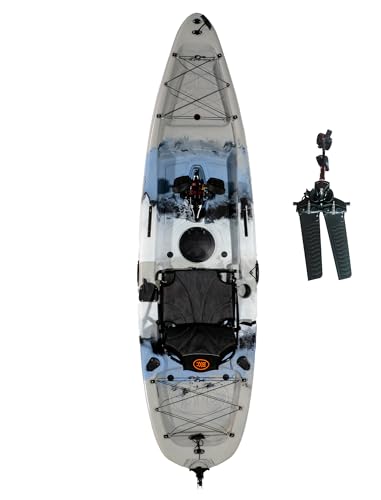
Brooklyn 10.0 Sit-On-Top Fishing Kayak by BKC
Should you’re after a stable, hands-free platform for all-day fishing, I’d point you to the Brooklyn 10.0 - its flipper-style pedal drive lets you cover water and keep your hands free for casting or electronics. I like its rotomolded HDPE hull for durability and the adjustable aluminum-frame seat with dry mesh for comfort. The hand-operated rudder gives sharp, responsive turns and good tracking, while scupper holes and multiple handles make transport and drainage easy. Angler features include two rod holders, an accessory rail for electronics, a watertight front hatch, and a bungeed rear cargo area. It’s rated for 350 lb and supported with five years.
- Propulsion Type:Flipper-style pedal drive (hands-free)
- Seating Style:Sit-on-top with adjustable aluminum-frame seat (dry mesh)
- Length:10 ft
- Fishing-Specific Features:Two built-in rod holders; accessory rail for fish finders/holders
- Portability / Transportability:Relatively lightweight hull with multiple carry handles; easy to carry
- Tracking / Steering:Hand-operated rudder for sharp, responsive turning and improved tracking
- Additional Feature:Rotomolded HDPE hull
- Additional Feature:Watertight front hatch
- Additional Feature:5-year warranty
Pelican Catch Kicker 110 HDII Pedal Fishing Kayak
Should you’re after a pedal kayak that makes long days on the water effortless, I’d point you to the Pelican Catch Kicker 110 HDII - its HyDryve II fin pedal system delivers smooth, low-fatigue propulsion and handles shallow, plant-choked water with ease. I appreciate the adjustable pedals and Catch Kicker rudder for precise tracking and easy steering from either side of the seat. The ErgoBoost seating raises for better sightlines and stays comfortable all day. At 11 feet and 59 pounds it’s surprisingly portable, with large metal in-handle grips and track grooves for mounting gear. The Amazonia finish looks sharp and ready for fishing.
- Propulsion Type:HyDryve II fin pedal system
- Seating Style:Sit-on-top with Ergoboost adjustable seat
- Length:11 ft
- Fishing-Specific Features:Accessory track grooves in handles; fishing-ready layout
- Portability / Transportability:Lightweight (59 lb) with mid-side metal handles for car-topping
- Tracking / Steering:Rudder (Catch Kicker) for straight tracking and steering control
- Additional Feature:Ergoboost elevated seat
- Additional Feature:In-handle track grooves
- Additional Feature:Lightweight 59 lbs
Spatium Pedal Fishing Inflatable Sit-on-Top Kayak
Should you want a versatile, easy-to-transport fishing platform that adapts to pedaling, paddling, or motorized cruising, I’d pick the Spatium pedal inflatable sit-on-top kayak-its removable pedal system and interchangeable rear fin let you switch modes quickly while the 360° rotatable seat and adjustable rail keep casting and comfort perfectly dialed in. I like the pedal drive’s forward, reverse, and steer control, hitting 6–8 km/h with stabilizing fins for straight tracking. The hull’s double-layer PVC is tough yet light; pipe and hull pressures are specified for safety. Built-in mounts, side fish measurements, and compact inflation make it ideal for one angler.
- Propulsion Type:Pedal-driven (removable pedal system)
- Seating Style:Sit-on-top inflatable with 360° rotatable seat
- Length:(inflatable) unspecified exact length in summary - designed as single-person fishing kayak (comparable compact)
- Fishing-Specific Features:Measurement scale on hull; camera/light base; fishing board mode
- Portability / Transportability:Inflatable for easy transport and storage
- Tracking / Steering:Steering lines and control levers with stabilizing fins for tracking
- Additional Feature:Three-mode convertible design
- Additional Feature:Built-in fish measurement
- Additional Feature:Inflatable, low-pressure hull
Reel Yaks Raptor 9.5ft Modular Fishing Kayak
Provided that you’re an angler who needs hands-free propulsion and easy transport, I’d recommend the Reel Yaks Raptor 9.5ft. I’ve found its fin-drive pedal system smooth, quiet, knee-friendly, and resistant to weed snags, working well in shallow water. The W-shaped sit-on-top hull gives surprising stability for standing and casting. Its modular, four-step snap-together design breaks into manageable 31-lb sections with integrated handles, so you can carry and store it without roof racks. With a 380-lb capacity, customizable accessory mounts, and compact profile for apartments or trunks, it’s a practical choice for anglers with limited lifting capacity.
- Propulsion Type:Fin drive pedal system
- Seating Style:Sit-on-top (W-shaped hull) with stable platform for seating
- Length:9.5 ft
- Fishing-Specific Features:Stable standing platform; customizable accessory mounting
- Portability / Transportability:Modular multi-piece design that snaps apart for compact transport
- Tracking / Steering:W-shaped hull and stable design for balance and tracking (plus fin drive helps steering)
- Additional Feature:Snap-together modular sections
- Additional Feature:Sections with integrated handles
- Additional Feature:Compact, space-saving storage
Factors to Consider When Choosing a Fishing Pedal Kayak
Selecting a fishing pedal kayak requires careful attention to the pedal system type and how it integrates with steering and tracking. Equally crucial are hull stability design and seating comfort level to guarantee safety and long sessions on the water. Storage and capacity determine gear load and mission suitability, tying the other factors together.
Pedal System Type
Upon choosing a fishing pedal kayak, the type of pedal system governs noise, maneuverability, and suitability for different water conditions. Fin-based drives use oscillating or prop-like fins beneath the hull, offering quiet, snag-resistant, knee-friendly propulsion ideal for shallow, vegetation-filled areas. Flipper-style systems convert pedal strokes into lateral fin motion, producing rapid acceleration and higher top speeds for long-distance cruising. Belt- or chain-driven propeller setups provide superior top-end speed and straight-line tracking but demand deeper water and are more prone to entanglement. Removable or modular units increase versatility allowing conversion to paddle-only or motorized configurations and ease transport. Finally, pedal adjustability and ergonomic drive positioning-reach, crank length, and seat-height compatibility-are critical to reduce fatigue and maximize pedaling efficiency.
Hull Stability Design
In considering hull stability design, anglers should evaluate how hull shape, beam, length, rocker, and construction features interact to determine both primary (at-rest) and secondary (underway or shifted-weight) stability. Flat-bottom hulls and wide beams (30″+) provide strong primary stability for standing and casting; V-hulls and narrower beams track better but feel tippier initially. Longer hulls with low rocker improve straight-line tracking and secondary stability at speed; shorter, rockered hulls turn more readily but can feel less stable during movement. Chines, keels, sponsons, and added stabilizing chines increase roll resistance and help resist tipping during sudden weight shifts. Finally, hull volume, freeboard, and thoughtful load distribution guarantee steadiness while carrying gear-low-volume or overloaded hulls become sluggish and prone to instability.
Seating Comfort Level
For anglers spending long hours on the water, seating comfort is a core factor that affects endurance, pedaling efficiency, and effectiveness while casting. Adjustable seats with breathable, quick-drying fabrics and integrated drainage or mesh panels reduce sweat and water buildup, maintaining comfort through extended sessions. Multiple adjustment points-height, fore-aft slide tracks, and recline-permit ergonomic pedaling and casting positions for varied leg lengths and torso heights. Raised seating improves sightlines and reduces knee strain; lower seats lower the center of gravity for added hull stability. Padded lumbar support and wide footprints distribute weight, minimize pressure points, and reduce fatigue and position shifting. Removable or modular seat systems with pockets and attachment points add utility and personalization without impacting cargo concerns.
Storage And Capacity
While evaluating storage and capacity, anglers should prioritize total payload and usable stowage over impressive hatch counts alone. Kayak selection should begin with a payload rating at least 50–100 lb above the combined weight of angler, gear, and accessories to maintain stability. Compare dry storage volumes (hatch liters or cubic feet) and open tankwell dimensions to confirm space for a cooler, tackle boxes, and a battery or livewell. Inspect gear retention features-bungee-secured stern tankwells, watertight hatches, and accessory rails-to safeguard tackle, electronics, and rods. Evaluate cockpit and deck clearance, including rear tankwell length/width, hatch placement, and footroom, for seated or standing access. Finally, account for empty hull weight plus estimated gear weight to guarantee safe transport and handling.
Steering And Tracking
While evaluating steering and tracking, anglers should weigh how rudder systems, hull geometry, and pedal-drive placement interact to hold a course and respond to corrections. Rudder systems-hand-operated or foot-controlled-provide precise directional control for tight turns and maintaining course in wind or current. Tracking depends on hull shape: longer, narrower hulls and keel or skeg designs resist yaw and hold a straight line. Pedal-drive placement and thrust line affect responsiveness; centrally mounted, low-profile drives preserve natural tracking, while side-mounted torque can induce yaw. Adjustable rudders or trim tabs allow fine-tuning for varied loads and conditions, reducing constant corrective inputs. Shallow-water fins, skegs, and low-drag pedal systems minimize interference and improve efficiency in vegetation or shallow areas.
Portability And Transport
Upon considering portability and transport, anglers should prioritize total weight, packable dimensions, and how the kayak disassembles or compresses for vehicle and storage fit; models under roughly 60 lb or modular/inflatable designs are markedly easier to lift, roof-rack, and carry solo. Buyers should measure folded or packed length, width, and height to confirm trunk, garage, and rack compatibility. Check whether the hull breaks into manageable sections and whether the pedal or fin drive must be removed for transport, noting removable-drive weight and attachment effort. Inspect handle placement-bow, stern, mid-ship-and material (metal versus molded plastic) for comfortable lifting. Finally, verify compatibility with common roof racks, tie-down points, and the vehicle’s mounted load capacity to select suitable hardware.
Accessory Mounting Options
Upon evaluating accessory mounting options, anglers should prioritize systems that provide multiple, standardized attachment points-such as 18mm accessory tracks and 1/4″-20 threaded inserts-so electronics, rod holders, and cameras can be added without drilling. Multiple tracks or rails along the cockpit and stern expand layout flexibility, permitting easy placement of fish finders, rod holders, and camera mounts. Integrated mounting points in handles, tankwells, or molded deck grooves provide secure locations for storage, cooler racks, or anchor trolleys. Removable or modular platforms-flat plates and track adapters-allow reconfiguration for casting, pedal access, or new electronics. Finally, verify load-bearing capacity and mount placement so heavy items (batteries, finders, coolers) sit near the kayak’s centerline to maintain balance and tracking.
Durability And Materials
At the selection stage, durability and material choice determine how a fishing pedal kayak will stand up to impacts, UV exposure, and frequent load stresses. Buyers should favor hulls of high-density polyethylene (HDPE) or multi-layer PVC with UV inhibitors: HDPE resists dents and impacts, while reinforced PVC keeps inflatables lightweight yet durable. Construction matters-rotomolded or thermoformed shells distribute forces and resist cracking; inflatables require double-stitched, heat-sealed seams. Verify rated material thickness (gauge for polyethylene, denier/mm for PVC) and any PSI or impact-strength figures to gauge longevity. Inspect reinforcement at keel, chines, cockpit rims, and accessory mounts-layups, rub rails, or backing plates reduce tearing and hardware pull-through. Finally, choose corrosion-resistant hardware and UV-stable coatings to prevent premature failure in marine environments.