Book Appointment Now

5 Best Aquarium LED Lights for Freshwater in 2026
ByIMRAN
You may worry these lights are too complex, but they’re actually easy to use and worth it for healthy plants and happy fish. You’ll find options that match different tank sizes, budgets, and skill levels while offering reliable timers, smart color control, and plant‑friendly spectra. Keep going to see clear comparisons and honest features for hygger, Lominie, Aqueon, NICREW, and more so you can pick the best fit for your aquarium.
| hygger Aquarium LED Light with 24/7 Day-Night Cycle |
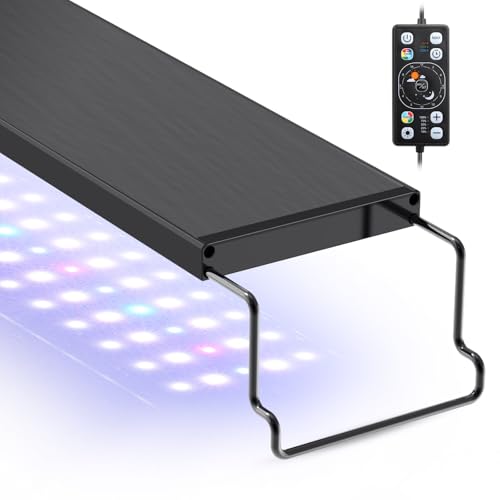
| Best for Plant Timers | Intended Use: Freshwater planted aquariums | Light Spectrum / Color Control: Full spectrum WRGB; 8 color components + 7 fixed colors | Dimming / Brightness Levels: 5 brightness levels (10/25/50/75/100%) | VIEW LATEST PRICE | Read Our Analysis |
| Lominie A20 16W LED Aquarium Light with Remote |

| Best Remote Control | Intended Use: Freshwater / planted tanks / refugium | Light Spectrum / Color Control: 4-channel full spectrum (sunrise/midday/sunset/night); color customization | Dimming / Brightness Levels: Dimming supported (via remote/controller) | VIEW LATEST PRICE | Read Our Analysis |
| Aqueon Freshwater Aquarium Clip-On LED Light One Size |

| Best Clip-On Simplicity | Intended Use: Freshwater aquariums (up to 20 gallons) | Light Spectrum / Color Control: White LED shimmer (single-spectrum, no multi-channel control) | Dimming / Brightness Levels: Single on/off (soft-touch control) - no multi-level dimming | VIEW LATEST PRICE | Read Our Analysis |
| Hygger LED Aquarium Light with Timer (18–24″) |
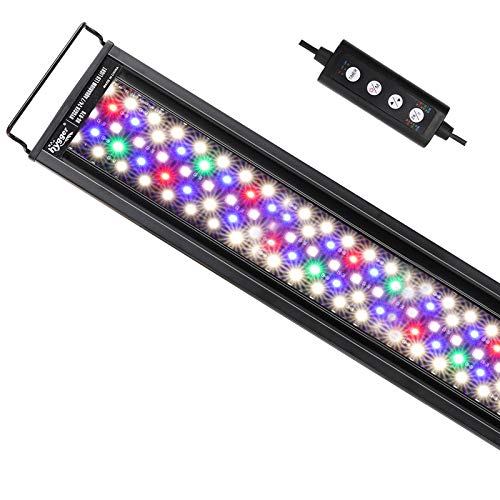
| Best Customizable Spectrum | Intended Use: Freshwater fish and planted tanks (18–24″) | Light Spectrum / Color Control: Full-spectrum white + RGB; multiple color choices (7 colors) | Dimming / Brightness Levels: 5 intensity levels (10/25/50/75/100%) | VIEW LATEST PRICE | Read Our Analysis |
| NICREW ClassicLED Gen2 Dimmable Aquarium Light 48-60 |

| Best Large-Tank Value | Intended Use: Freshwater (also suitable for saltwater) | Light Spectrum / Color Control: 6500K white + 460 nm blue; 2-channel white/blue control | Dimming / Brightness Levels: 2-channel dimmable (white and blue independently) | VIEW LATEST PRICE | Read Our Analysis |
More Details on Our Top Picks
hygger Aquarium LED Light with 24/7 Day-Night Cycle
Should you want an easy, reliable light that guides your plants through a full day and night cycle, the hygger Aquarium LED Light is a smart pick for beginner and experienced freshwater hobbyists alike. You’ll enjoy a true 24/7 cycle with smooth sunrise, sunlight, sunset, and night transitions, plus custom schedules in two hour steps. The WRGB full range and seven single colors let you tune hues and plant needs. Brightness shifts across five levels and a memory function restores settings after outages. The slim aluminum body keeps heat down, splash resistant lens protects LEDs, and extendable brackets fit 12 to 18 inch tanks.
- Intended Use:Freshwater planted aquariums
- Light Spectrum / Color Control:Full spectrum WRGB; 8 color components + 7 fixed colors
- Dimming / Brightness Levels:5 brightness levels (10/25/50/75/100%)
- Scheduling / Timer:24/7 day-night cycle + custom 2‑hour schedule; built-in timers 6/10/12 h; memory
- Mounting / Fit:Extendable metal brackets; fits 12–18″ tanks; clip/legs included
- Power / LED Type & Output:14W; three-row 2835 LEDs + two-row 5054 WRGB; 590 lumens
- Additional Feature:Memory restores after outage
- Additional Feature:PC splash-resistant lens
- Additional Feature:Extendable metal brackets
Lominie A20 16W LED Aquarium Light with Remote
Should you want a simple, flexible LED that fits planted freshwater tanks and small refugiums, the Lominie A20 16W delivers the features most hobbyists need. You get a 4-channel full range with sunrise, midday, sunset, and night modes that create a natural 24/7 cycle. The 16 LEDs run at about 6933K and support color customization, timing, and dimming. A remote is included for easy control while a smart WIFI controller is sold separately for group control and advanced programming. The adjustable 360-degree gooseneck and clip clamp protect glass and let you aim light to enhance plant growth and color.
- Intended Use:Freshwater / planted tanks / refugium
- Light Spectrum / Color Control:4-channel full spectrum (sunrise/midday/sunset/night); color customization
- Dimming / Brightness Levels:Dimming supported (via remote/controller)
- Scheduling / Timer:24/7 natural cycle (sunrise/midday/sunset/night); timing programmable (remote/controller)
- Mounting / Fit:Adjustable 360° gooseneck boom with clip clamp (fits up to 25 mm glass)
- Power / LED Type & Output:16W; 16 high-quality LEDs; ~6500K/6933K color temp
- Additional Feature:Includes handheld remote
- Additional Feature:360° gooseneck positioning
- Additional Feature:Clip clamp with glass protection
Aqueon Freshwater Aquarium Clip-On LED Light One Size
In case you want an easy, no-fuss way to brighten a small freshwater tank, the Aqueon Freshwater Aquarium Clip-On LED Light is a great fit for hobbyists who value simplicity and style. You’ll find it mounts easily on framed or frameless tanks thanks to a versatile screw that grips securely. It works best for aquariums up to 20 gallons and installs in seconds with the clip-on design. Twenty one bright LEDs give a shimmering effect and the super-thin profile keeps attention on your fish and plants. A two-way soft-touch control keeps operation simple and reliable for daily use.
- Intended Use:Freshwater aquariums (up to 20 gallons)
- Light Spectrum / Color Control:White LED shimmer (single-spectrum, no multi-channel control)
- Dimming / Brightness Levels:Single on/off (soft-touch control) - no multi-level dimming
- Scheduling / Timer:No programmable timer (simple on/off control)
- Mounting / Fit:Clip-on mount for framed or frameless aquariums (up to 20 gal)
- Power / LED Type & Output:(Low-power) 21 LEDs; clip-on LED bar (wattage not specified)
- Additional Feature:Super-thin elegant design
- Additional Feature:Versatile mounting screw
- Additional Feature:Quick clip-on installation
Hygger LED Aquarium Light with Timer (18–24″)
Should you want an easy, reliable way to make a freshwater tank look alive while keeping maintenance simple, the Hygger LED Aquarium Light with Timer fits the bill. You’ll get bright full range light from 56 white 6500K LEDs plus blue, red, green, and 20 RGB LEDs. It delivers 1075 lumens to enhance fish and plant colors. The adjustable legs fit 18 to 24 inch tanks securely. Use 24/7 mode for sunrise to starry night cycles or DIY mode for timed runs, color choices, and five intensity levels. The built-in timer and DC adapter keep operation safe and energy efficient.
- Intended Use:Freshwater fish and planted tanks (18–24″)
- Light Spectrum / Color Control:Full-spectrum white + RGB; multiple color choices (7 colors)
- Dimming / Brightness Levels:5 intensity levels (10/25/50/75/100%)
- Scheduling / Timer:24/7 mode with default auto on/off and adjustable times; DIY timers 6/10/12 h
- Mounting / Fit:Adjustable sliding/mounting legs for 18–24″ tanks
- Power / LED Type & Output:5050 white + RGB LEDs: total LED counts listed; 1075 lumens; 6500K
- Additional Feature:Built-in programmable switch
- Additional Feature:DC-powered energy efficient
- Additional Feature:Adjustable sliding mounting legs
NICREW ClassicLED Gen2 Dimmable Aquarium Light 48-60
Provided you want a reliable, no-fuss light that helps plants thrive without overwhelming your tank, the NICREW ClassicLED Gen2 Dimmable for 48–60 inch aquariums is a smart pick. You’ll get 40 watts of power and a length that fits larger setups, with 6500K whites and 460 nm blues tuned for plant photosynthesis and vivid fish colors. You can dim white and blue independently to warm or cool the look. Timers offer 8, 10, or 12 hours plus gentle 15-minute ramp up and down. Bracketed mounting makes installation simple, and the brightness beats the prior model.
- Intended Use:Freshwater (also suitable for saltwater)
- Light Spectrum / Color Control:6500K white + 460 nm blue; 2-channel white/blue control
- Dimming / Brightness Levels:2-channel dimmable (white and blue independently)
- Scheduling / Timer:Built-in timers 8/10/12 h; 15‑minute ramp up/down
- Mounting / Fit:Bracketed mounting; fits 48–60″ aquariums (light length 45.6″)
- Power / LED Type & Output:40W; 6500K white + 460 nm blue LEDs; 50% brighter than prior gen
- Additional Feature:2-channel independent dimming
- Additional Feature:15-minute ramp transitions
- Additional Feature:50% brighter Gen2 LEDs
Factors to Consider When Choosing Aquarium Led Lights for Freshwater
Once you choose LED lights for your freshwater tank, consider the light range, brightness and PAR, and the color channels you need so plants and fish look and grow their best. You’ll also want to set a reliable photoperiod with timers and make sure the fixture mounts correctly and fits your tank size. These factors connect directly-range and color affect plant health, brightness and PAR determine growth, and timers plus proper mounting keep your setup consistent and stress-free.
Light Spectrum Needs
Although lighting can seem technical, choosing the right range for a freshwater planted tank is something you can handle with confidence. You’ll want full spectrum lighting near 6500K to mimic daylight and fuel photosynthesis. Mix white LEDs with added blue and red components so plants get both balanced light and targeted wavelengths. Blue light around 430 to 470 nm enhances chlorophyll absorption and improves color. Red around 620 to 660 nm drives photosynthesis and supports stem growth. Choose fixtures that combine broad white output with peaks near 460 nm and 650 nm rather than single color strips. Also use sunrise and sunset cycles with reduced blue and lower intensity to mimic nature and lower stress for plants and fish.
Brightness And PAR
Dial in the right brightness and you’ll see your plants thrive and your algae stay in check. You want PAR, not just lumens, because PAR measures usable light for photosynthesis between 400 and 700 nm. Aim for roughly 20 to 50 µmol·m⁻²·s⁻¹ for low-light plants, 50 to 150 for medium, and over 150 for high light species. Keep in mind lumens and watts reflect human sight, not plant needs, so use PAR maps or a sensor at plant height. Light falls off with distance and through water, so measure where leaves sit. Pick fixtures with dimming and multi-level output so you can match intensity and lower algae risk. Also check spectrum balance, since blue and red peak wavelengths drive photosynthesis better than non PAR output.
Photoperiod And Timers
You’ve already got the light intensity right for your plants, now consider how long that light stays on. Set a consistent photoperiod of about 8 to 12 hours daily to help photosynthesis and keep algae in check. Use built-in or external timers that offer gradual ramp up and ramp down over 15 to 30 minutes so fish and plants don’t get startled by sudden shifts. Choose fixtures with programmable 24/7 cycles that let you define sunrise, midday, sunset, and night phases to mimic natural rhythms and enhance plant color and fish health. Look for adjustable duration presets and custom 2 to 24 hour schedules to match species needs. Make sure power outage memory or backup so your schedule restores without upsetting the tank.
Color Channels Available
As you pick aquarium LED lights, look closely at the color channels they offer because those channels let you shape both plant growth and how your tank looks. You’ll want multiple channels like red, green, blue, and white so you can fine tune range for photosynthesis and color rendition. Blue at 450 to 460 nm enhances chlorophyll absorption, keeps plants compact, and makes fish fluorescence pop. Red at 600 to 630 nm raises photosynthetic efficiency and helps carpeting and stem plants thrive provided balanced with blue and white. White or full spectrum around 5000 to 7000K gives broad PAR and a natural look, and tunable whites shift warmer or cooler tones. Independent dimming and timing across channels lets you mimic day night cycles and tailor intensity for growth stages.
Mounting And Fit
Consider how your light will sit on the tank before you buy it, because a good mount makes the difference between even plant growth and awkward hotspots. Measure your tank width and glass thickness initially, including any rim, then pick fixtures or brackets rated for that span and mm thickness. Check mounting type compatibility: clip-on clamps, extendable legs, gooseneck booms, or hanging kits. Make sure clamp pressure fits framed or frameless tanks and bracket height clears lids and tall plants. Confirm adjustable range so you can slide or lift the light for maintenance. Look for aluminum housings and PC lenses to limit heat transfer and resist splashes at the mount. Should you need off-center positioning, choose a 360° rotating arm or flexible mount for even coverage.
Heat And Durability
Anytime lights run hot they don’t just dim faster, they can raise your tank temperature and stress your fish and plants, so pick fixtures that manage heat well and stand up to humidity. You’ll want aluminum housings and good heat sinks because they move heat away from diodes and keep LEDs running cooler. Cooler diodes last longer and keep color and brightness stable. Look for low wattage per gallon or models with passive or active cooling to avoid warming the water. Also check for anodized aluminum, stainless mounts, sealed lenses, and splash-resistant designs so moisture won’t corrode parts. Favor units with memory and power-fail recovery to cut thermal cycling. That combination protects electronics, extends life, and keeps your tank calm and healthy.
Energy Use Efficiency
Should you want bright, healthy plants without a surprise spike in your electric bill, pick LED lights that make the most light for each watt they use. Look for high lumens per watt; good fixtures give 50 to 100 lm/W or more, so you get strong output with less draw. Also choose lights with programmable dimming and timers. That lets you run lower intensity periods like ramped sunrise and sunset, which cuts average energy use while keeping plant photoperiods. Consider total wattage per tank volume, but focus more on lumens or PAR per watt for real efficiency. Prefer spectra peaked near 450 nm and 660 nm so plants use light more effectively. Finally pick units with solid heat dissipation to avoid lumen loss over time.
