Book Appointment Now

6 Best Artificial Light for Aquarium Plants in 2026
ByIMRAN
You want the healthiest, most lively planted tank in 2026, and choosing the right light makes that simple. Start with full-range LEDs like SEAOURA or AQQA for balanced PAR and color, pick clip-ons from Hygger or SEAOURA for small setups, and choose extendable AQUANEAT or AQQA fixtures for wider tanks. Look for high CRI, memory timers with sunrise and sunset ramping, IP68 protection, and matched wattage for your plants’ needs - and keep reading to find the perfect fit.
SEAOURA Full-Spectrum LED Aquarium Plant Light (12–18″)

Should you want a simple, reliable light that helps both plants and fish thrive, the SEAOURA full-spectrum LED for 12 to 18 inch tanks is a strong choice. You’ll get 6500 K white light with CRI up to 89%, so colours look natural and plants photosynthesize well. The DIY mode lets you set time, colour, and brightness, while timers of 6, 10, or 12 hours simplify routines. Brightness has 10 levels and memory restores settings after power loss. Soft ramp-up and dimming ease fish stress. The compact SMD2835 layout, ABS shell, and sturdy metal bracket make installation and heat control effortless.
Best For: Aquarium hobbyists with 12–18″ freshwater tanks who want an easy-to-use, full-spectrum LED that supports plant growth and reduces fish stress.
Pros:
- Simple DIY mode with timers (6/10/12 h), 10 brightness levels, and memory to restore settings after power loss.
- Full-spectrum 6500 K light with up to 89% CRI and soft ramping/dimming to promote plant photosynthesis and natural-looking colors while reducing fish stress.
- Compact SMD2835 LED layout, ABS shell for heat dissipation, and sturdy adjustable metal brackets for easy installation on most tanks.
Cons:
- Specifically sized for 12–18″ tanks, so not suitable for larger or very small aquariums.
- Limited colour mode options (All, individual White/Red/Green/Pink, or Blue only) may not suit users wanting advanced spectrum tuning.
- No mention of wireless/app control or built-in sensors, so scheduling and adjustments are manual via the controller.
Hygger Clip-On Aquarium LED Light with Timer
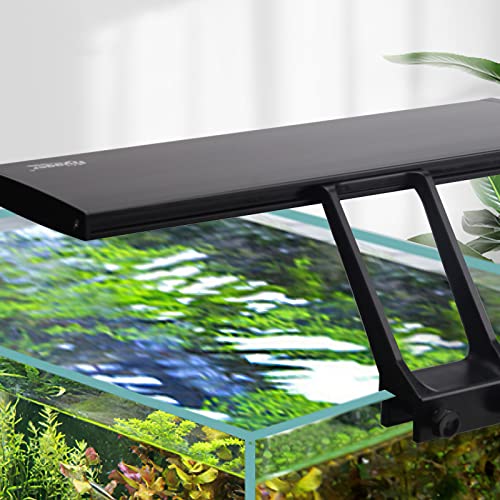
In case you want a simple, reliable light that makes your planted tank look natural without constant fiddling, the Hygger Clip-On Aquarium LED with Timer is a smart pick. You get a default 24/7 natural schedule with sunrise, daylight, and moonlight gradients, plus DIY mode to set time, brightness, and color. Timer offers 6, 10, or 12 hours; cycle color runs without brightness control. The 14 W lamp has 68 LEDs, 817 lumens, CRI 85, and 50,000 hour life. A sturdy clip fits 12 to 20 inch tanks, with separable adapter, good heat dissipation, and flexible cord lengths.
Best For: Aquarists with small to medium planted tanks (12–20″) who want a low-fuss, natural-looking 24/7 lighting schedule with optional DIY control.
Pros:
- Default 24/7 natural schedule (sunrise, daylight, moonlight) plus DIY mode for full-spectrum time, color, and brightness control.
- Good optical specs for the size: 14 W, 68 LEDs, 817 lumens, CRI ~85, and rated 50,000-hour life.
- Sturdy, versatile clip-on design (fits up to 0.9″ glass) with separable adapter and improved heat dissipation.
Cons:
- Cycle color mode lacks brightness adjustment.
- Limited recommended coverage (best for 12–20″ aquariums), may be underpowered for larger or heavily planted tanks.
- Timer presets (6/10/12 h) may be less flexible than programmable schedules for some users.
SEAOURA Clip-On Aquarium Plant Light with Timer

Should you want a simple, reliable light that makes low- to medium-light aquarium plants thrive, the SEAOURA clip-on lamp is a smart choice that’s built for everyday users and hobbyists who value ease and control. You’ll get full spectrum 6500K white plus seven single colors and a cycle mode that moves from sunrise to moonlight. You can preview colors and set ten intensity levels, though cycle mode keeps intensity fixed. The five timers and 16 schedule points automate days, and after outages the lamp retains settings. Its slim aluminum body, IP68 waterproofing, and adjustable clip fit 7 to 12 inch tanks.
Best For: Aquarium hobbyists and beginners who want an easy-to-use, durable clip-on LED light that supports low-to-medium light plant growth with programmable timers.
Pros:
- Slim, durable aluminum clip-on design with adjustable bracket fits 7–12″ tanks and works on glass or acrylic (rimmed or rimless).
- Full-spectrum 6500K white plus seven colors, 10 intensity levels, preview feature, and cycle mode for automated day/night lighting.
- IP68 waterproofing, flicker-free 5054/2835 LEDs, 30,000-hour lifespan, and remembers settings after power outages.
Cons:
- Cycle mode does not allow intensity customization.
- Designed for medium-to-low light plants only-may not support high-light-demand species.
- Clip-on fit limited to 7–12″ tank heights, may not suit taller aquariums.
AQQA LED Extendable Full-Spectrum Aquarium Light

Should you want a simple, reliable light that helps your aquarium plants thrive and looks great on your tank, the AQQA LED Extendable Full-Range Aquarium Light is a smart pick. You’ll like its widened aluminum shell and sturdy metal housing that clean easily and shed heat fast. Premium 5050 and 2835 LEDs give bright full-range light to support growth and vivid color. It offers nine colors, ten brightness levels, DIY and timer modes, and memory so settings stick. The IP68 rating means it tolerates moisture. The extendable bracket fits 18 to 24 inch tanks and suits freshwater planted setups.
Best For: Aquarists with 18–24 inch freshwater or planted tanks who want a durable, easy-to-clean full-spectrum LED fixture with customizable timing and brightness to support plant growth and enhance tank appearance.
Pros:
- Durable, heat-dissipating aluminum housing with a widened gloss shell for easy cleaning and attractive appearance.
- Full-spectrum 5050/2835 LEDs with 9 colors, 10 brightness levels, DIY mode, and memory for versatile lighting and plant support.
- IP68 waterproofing and an extendable bracket designed for 18–24 inch tanks, suitable for submerged or high-moisture environments.
Cons:
- Designed specifically for 18–24 inch tanks, so it may not fit larger or much smaller aquariums without compromise.
- Advanced features (DIY modes, timer adjustments) may be more than casual hobbyists need or expect to configure.
- Only three timer presets (6H/10H/12H) and default automatic schedule may lack fine-grained scheduling for some users.
AQUANEAT LED Full-Spectrum Aquarium Light (18–24″)
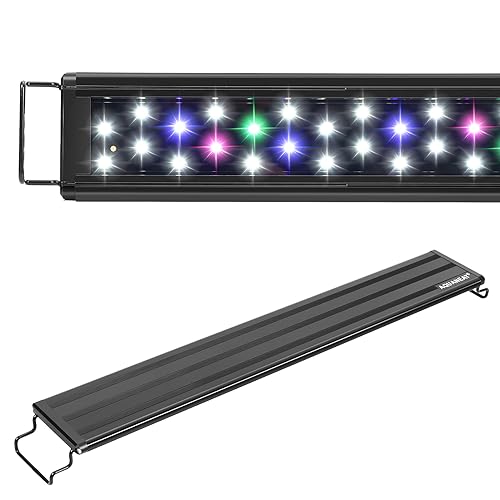
Should you want a simple, budget-friendly light that’s easy to set up and fits small tanks, the AQUANEAT LED Full-Range is a great pick for beginner hobbyists and busy plant keepers. You’ll get a compact fixture that fits 18–24 inch tanks and works best on a 10 gallon with 20 inch length. It includes two extendable docking brackets so you can adjust the fit. The 42 LEDs mix 6500K white with blue, pink, and green diodes to give full-range output for freshwater plants. Controls are simple on or off, no dimmer or timer. Keep it dry; it’s not waterproof.
Best For: beginner hobbyists and busy freshwater plant keepers who want a simple, budget-friendly light that’s easy to set up for 18–24″ (best on a 10‑gal 20″ tank).
Pros:
- Compact, easy-to-install fixture with extendable brackets to fit 18–24″ tanks.
- Full-spectrum 42-LED array (6500K white plus blue, pink, green) suitable for basic freshwater plant growth.
- Energy-efficient and affordable option for beginners.
Cons:
- Only two modes (on/off) with no dimmer or timer for lighting control.
- Not waterproof-must be kept away from splashes.
- Limited to small tanks and may lack intensity/adjustability for demanding planted setups.
AQQA LED Extendable Aquarium Light for 24–32″ Tanks
Should you want a reliable, all-in-one LED for a 24 to 32 inch planted aquarium, the AQQA extendable light is built to give your plants steady growth and your tank a natural look. You’ll like its widened aluminum gloss shell and alloy housing, which feel sturdy and cool to the touch while shedding heat fast. The 5050 and 2835 LEDs give bright full range light that supports plant growth and vivid fish colors. It’s IP68 waterproof so you can mount near water without worry. Use the 24/7 default or DIY mode, pick from nine colors, ten brightness levels, and set timers.
Best For: Aquarists with 24–32″ planted or freshwater tanks who want a durable, waterproof, full-spectrum LED that promotes plant growth and offers customizable light modes.
Pros:
- Wide aluminum housing with alloy construction for fast heat dissipation and a sturdy, attractive finish.
- IP68 waterproof rating and extendable bracket fit most 24–32″ tanks for versatile mounting near water.
- Full-spectrum 5050/2835 LEDs, 9 colors, 10 brightness levels, 24/7 default cycle and DIY/timer modes support plant growth and aesthetic control.
Cons:
- Extendable bracket supports 24–32″ tanks only, so not suitable for much larger or smaller tanks.
- Advanced customization may require familiarity with controls; no smart app or wireless control mentioned.
- Metal housing and bright LEDs may be overkill for low-light-only setups or sensitive shrimp tanks.
Factors to Consider When Choosing Artificial Light for Aquarium Plants
As you pick lighting for aquarium plants, consider the range, intensity, and how long the lights will run each day because each affects growth and color. Also check that the fixture fits your tank size, won’t overheat, and is built to last so you don’t stress over failures. I’ll walk you through matching wavelengths to plant needs, measuring PAR and intensity, setting timers, and choosing durable, properly sized fixtures so you feel confident with your choice.
Light Spectrum Match
Should you want your aquarium plants to thrive, matching the light range to their needs matters more than just choosing a bright fixture. You should pick lights that highlight blue 400 to 500 nm and red 600 to 700 nm wavelengths because plants use those bands for photosynthesis. A full range around 6500 K gives natural daylight feel and helps both plant growth and how your tank looks. Check for a high CRI of 80 or above so colors stay true while photosynthesis gets what it needs. Rather than chasing wattage, review PAR and spectral distribution charts to confirm adequate output across 400 to 700 nm for your plant density and depth. Avoid lights heavy in green only output because green light supports appearance more than growth.
Intensity And PAR
You matched your light range to what plants love, and now you’ll want to check how much usable light actually reaches their leaves. PAR measures the light plants use for photosynthesis, not lumen or lux, so you should read PAR charts whenever choosing fixtures. Low-light plants need about 20 to 50 µmol·m⁻²·s⁻¹, medium types about 50 to 100, and high-light species often want over 100 at the substrate. Intensity drops with distance, roughly according to the inverse square, so mounting height and beam spread matter. Aim for even PAR across the tank with wider beam angles or multiple LED rows to avoid shaded spots and algae hotspots. Don’t simply crank brightness. Match PAR to plant needs and to nutrients and CO2 for balanced growth.
Photoperiod And Timers
Because light timing shapes plant health as much as light intensity, setting a clear daily schedule is one of the smartest moves you can make for a planted tank. You’ll aim for roughly 8 to 12 hours of light most days, since shorter runs cut photosynthesis and longer runs above about 12 to 14 hours invite algae. Use a programmable timer that ramps up and down over 10 to 30 minutes to simulate sunrise and sunset, which calms fish and avoids sudden shocks. Pick adjustable options like 6, 10, or 12 hour presets so you can match species and conditions and limit total daily light energy. Choose timers with automatic resume after power loss. Stagger intensity to peak at midday and taper toward evening for healthier, more efficient growth.
Fixture Size Compatibility
Upon choosing a light fixture for your planted tank, match its size and mounting to the tank so every inch of the substrate gets usable light. You want the fixture length to span the tank so ends do not stay dark. Pick common lengths like 12, 18, 24, 30 inches or longer to match your aquarium. Next check brackets and clips so they fit rimmed or rimless glass or acrylic without wobble. Also consider about fixture width and LED layout so light spreads evenly and avoids bright hot spots. Consider the fixture’s rated depth so bulbs reach the substrate in taller tanks. Finally verify clearances for lids, filters, CO2 gear and spray bars so you can mount the light at the right height.
Heat And Durability
Upon lighting for a planted aquarium, paying attention to heat and durability will keep your plants healthy and your gear working for years. Choose fixtures with metal or aluminum housings and built in heat dissipation features. That thermal management keeps LED output stable and extends bulb life. Check LED chip types and rated lifespans; picking higher rated components prevents premature dimming and color shift. Also make sure the enclosure has an appropriate ingress protection rating so moisture and corrosion won’t ruin electronics. Look for strong mounting hardware, brackets, and a solid shell so your light won’t warp or drop into the tank. Finally, weigh overall build quality and warranty or support. These signs show the manufacturer expects the unit to resist heat, moisture, and electrical wear.
Frequently Asked Questions
Can Aquarium Lights Affect Fish Sleep Cycles Long-Term?
Yes - artificial aquarium lights can disrupt fish sleep cycles long-term provided you keep them improperly timed or too bright; you’ll need consistent photoperiods, dimming at night, and occasional dark periods to preserve natural rhythms and health.
Do Different Plant Species Need Separate Light Spectrums?
Yes - different plant species prefer different ranges; you’ll choose fuller red/blue for growth-heavy species, broader band for mixed or low-light plants, and tweak intensity/photoperiod so each species gets optimal photosynthetic and developmental cues.
How to Prevent Algae Blooms From Increased Lighting?
Start through cutting light duration and intensity, yet keep strong plant dosing; you’ll limit algae while supporting plants. You’ll balance nutrients, add CO2 or plants that outcompete algae, clean regularly, and avoid sudden light spikes to prevent blooms.
Are LED Lights Safe for Breeding or Fry Development?
Yes, LED lights are safe for breeding and fry development provided you use dimmable, full-spectrum fixtures, avoid intense direct illumination, maintain stable photoperods, and provide shaded areas; you’ll promote growth without stressing parents or sensitive fry.
Can Smart Lighting Integrate With Aquarium Controllers?
Yes - smart lighting can integrate with aquarium controllers. You’ll weave light and tech like a conductor guiding an orchestra; you’ll link schedules, sensors, and alerts via protocols or hubs, syncing spectra, timers, and automation for healthier, predictable tanks.